Hexagonal Architecture in Distributed Systems: Lessons from Automotive
Coupling your core business logic to a framework like Spring Boot or directly to a database is like welding a car’s engine straight onto its chassis: hit one pothole, and the entire cabin vibrates until it cracks. When I was working at Daimler on the connected vehicle platform, we found ourselves facing that exact dilemma.
We had dozens of microservices ingesting data and every time a third-party API or database schema changed, it triggered an unacceptable domino effect across our platform.
To eliminate that fragility, we adopted Hexagonal Architecture (Ports and Adapters) paired with CQRS in Java. Here is how we structured the solution, which shortcuts backfired, and the hard-won engineering lessons we learned along the way.
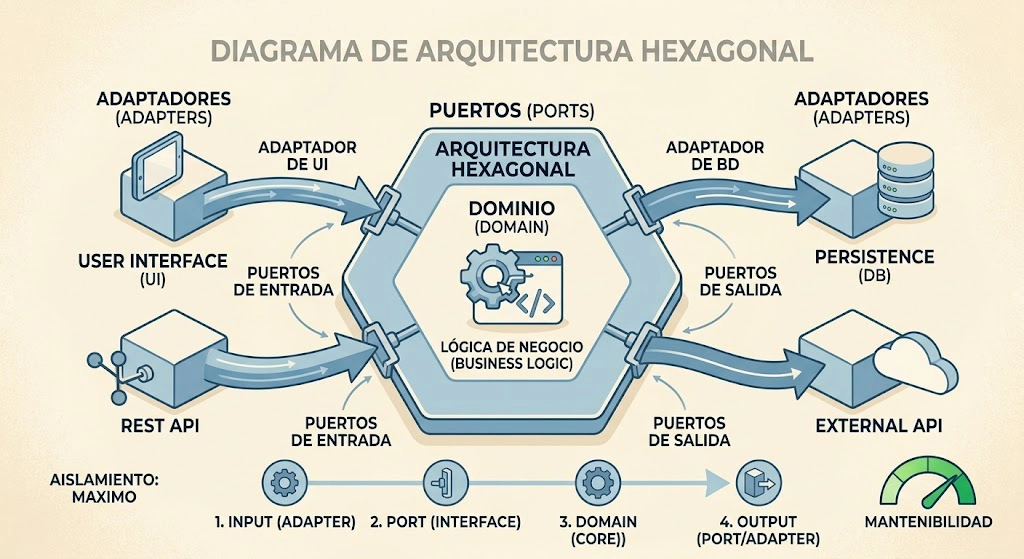
1. Why the Shift? The Initial Bottleneck
Most services begin life with the standard layered setup (Controller ➔ Service ➔ Repository) centered heavily around Spring Data JPA. It works fine initially, but as scale increases, three major pain points surfaced:
- Framework hostage crisis: Core domain entities were littered with Hibernate annotations (
@Entity,@Table,@ManyToOne). Any tweak to how data was persisted required editing business logic. - Sluggish test suites: Validating basic business logic forced us to boot up the entire Spring application context via
@SpringBootTest. CI/CD pipelines crept from minutes to nearly half an hour. - Read and write contention: The same domain aggregates were pulled into memory both for strict transactional writes and for lightweight dashboard reads, dragging down overall throughput.
2. The Strategy: Ports, Adapters, and CQRS
Our goal was simple: the domain had to be pure Java, completely oblivious to frameworks, message brokers, or storage backends. We split the architecture across three key pillars:
- Ports and Adapters: The core domain defines ports (clean Java interfaces) for inbound and outbound operations. External systems—such as REST controllers, Kafka listeners, and PostgreSQL repositories—act as interchangeable adapters that implement those contracts. If we upgrade Spring Boot or switch databases tomorrow, the business core remains untouched.
- Clear Boundary Separation with CQRS:
We split system interactions into two distinct pipelines:
- Commands: State-mutating actions (e.g., updating fleet telemetry or vehicle status). They route through the domain, enforce business invariants, and emit events.
- Queries: Read-only lookups for analytics dashboards. They bypass the heavy domain models entirely and hit database read models optimized for ultra-low latency.
- Custom Annotation-Driven Tooling:
Manually wiring ports and adapters across dozens of microservices created excessive boilerplate. To keep developer ergonomics high, we built internal Spring annotations (
@CommandHandler,@QueryHandler,@UseCase) coupled with a lightweight dispatcher that routed operations automatically at runtime.
3. The Reality Check: The JSONB Trap
To avoid constantly rewriting tables for each new car model, we took a tempting shortcut: dumping dynamic sensor payloads into a PostgreSQL JSONB column.
“Flexible schema, zero migration headaches,” we told ourselves. It turned out to be our biggest architectural mistake.
- Cryptic query syntax: The moment product teams needed aggregated filters on specific sensor keys, our SQL queries devolved into unreadable chains of
->>,#>>, andjsonb_extract_path. - Resource-hungry GIN indexes: To keep search queries from stalling out, we had to introduce heavy GIN indexes. These indexes bloated disk usage on our RDS instances and crippled continuous telemetry write throughput.
- Complexity didn’t disappear—it moved: Without a strict schema enforced by the database, type-checking and schema-evolution guarantees fell on Java adapters, introducing far more application complexity than we originally saved.
We ultimately made the call to rip out JSONB entirely and rebuild on a structured relational schema. Fortunately, we took this decision early enough to avoid the headache of a massive live production migration.
4. Extreme Rigidity vs. Pragmatism: The 500 Value Objects Trap
When teams embrace Domain-Driven Design (DDD) and hexagonal architecture with almost religious fervor, over-engineering is just around the corner. We fell right into that trap.
In pure textbook theory, every single domain concept should be encapsulated in an immutable Value Object with its own validation logic. In real-world practice, this spiraled out of control: we ended up creating hundreds of tiny classes that were nothing more than thin, artificial wrappers around a primitive String, Integer, or Boolean:
VehicleVinwrapping a String.EngineDisplacementwrapping an Integer.ExteriorColorwrapping a String.IsActivewrapping a Boolean.
The consequence? Moving simple data from an HTTP endpoint down to the database required unpacking, converting, validating, and repacking dozens of trivial primitives across endless mapper layers. Adding a single field to an entity forced modifications across 10 different files. It ground day-to-day engineering velocity to a halt.
What actually worked:
- Explicit Input and Output Objects: Using clear, dedicated Input and Output DTOs to cross port boundaries kept contracts strictly isolated without polluting the core domain.
- Pragmatic primitives: If an attribute doesn’t guard complex invariants, keeping it as a plain language primitive inside your entity is ten times healthier than maintaining 500 artificial wrapper classes.
5. Key Takeaways and Results
Once we completed the transition across our microservice fleet and pruned the architectural over-engineering, the operational gains were undeniable:
- Domain tests in milliseconds: Running our domain test suite went from 20 minutes down to under 30 seconds, giving developers instant local feedback without booting Spring.
- True infrastructure independence: We successfully upgraded core frameworks and replaced messaging adapters without altering a single line of Daimler’s core business logic.
The big lessons we took away:
- Beware of Value Object dogmatism: Not every piece of data needs its own class. Input and Output objects provide the ideal architectural boundary; wrapping every primitive only generates friction.
- JSONB is no replacement for relational modeling: Shortcuts with unstructured data in transactional systems quickly turn into an operational nightmare.
- CQRS pays for itself: Investing upfront in custom annotations and command buses required several weeks of foundational work, but it paid compounding dividends as the team expanded to dozens of consistent microservices.